
Pirate Outlaws 2: Heritage Early Access Impressions
Sequels are exciting. From the moment they are announced (or leaked), they bring about a plethora of emotions ranging from “ooooooohhhhh” to “yes!!!” or even “why?” and “seriously??" For me, sequels generally fall in the former category of excitement. For this game in particular, I was ecstatic upon hearing the news as 1) I loved the first one so much that I actually put in significant hours on the mobile version, and 2) I prefer this over a certain fan-favorite game (that also happens to be getting a sequel this year). Will Early Access have me hyped for the full release or will we be walking the plank?

Developed by Fabled Game, Pirate Outlaws 2: Heritage is the sequel to 2019’s Pirate Outlaws. Despite falling under most people’s radar to another deckbuilder, Slay the Spire, Pirate Outlaws received generally positive reviews, including a very positive rating on Steam. Like its predecessor, Heritage is a “…swashbuckling roguelike deckbuilder (Steam).” Become a pirate of infamy or die trying.
GAMEPLAY
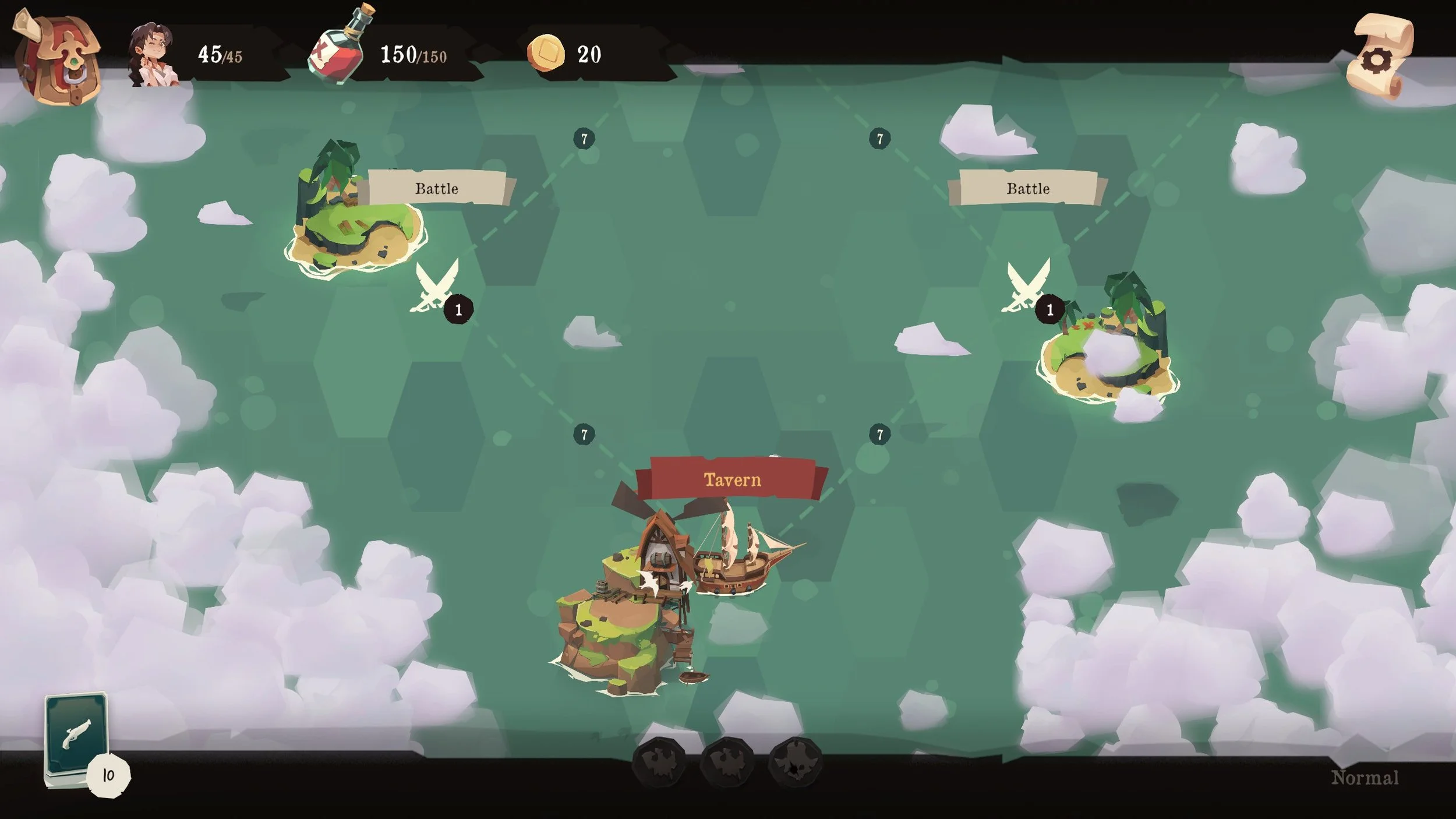
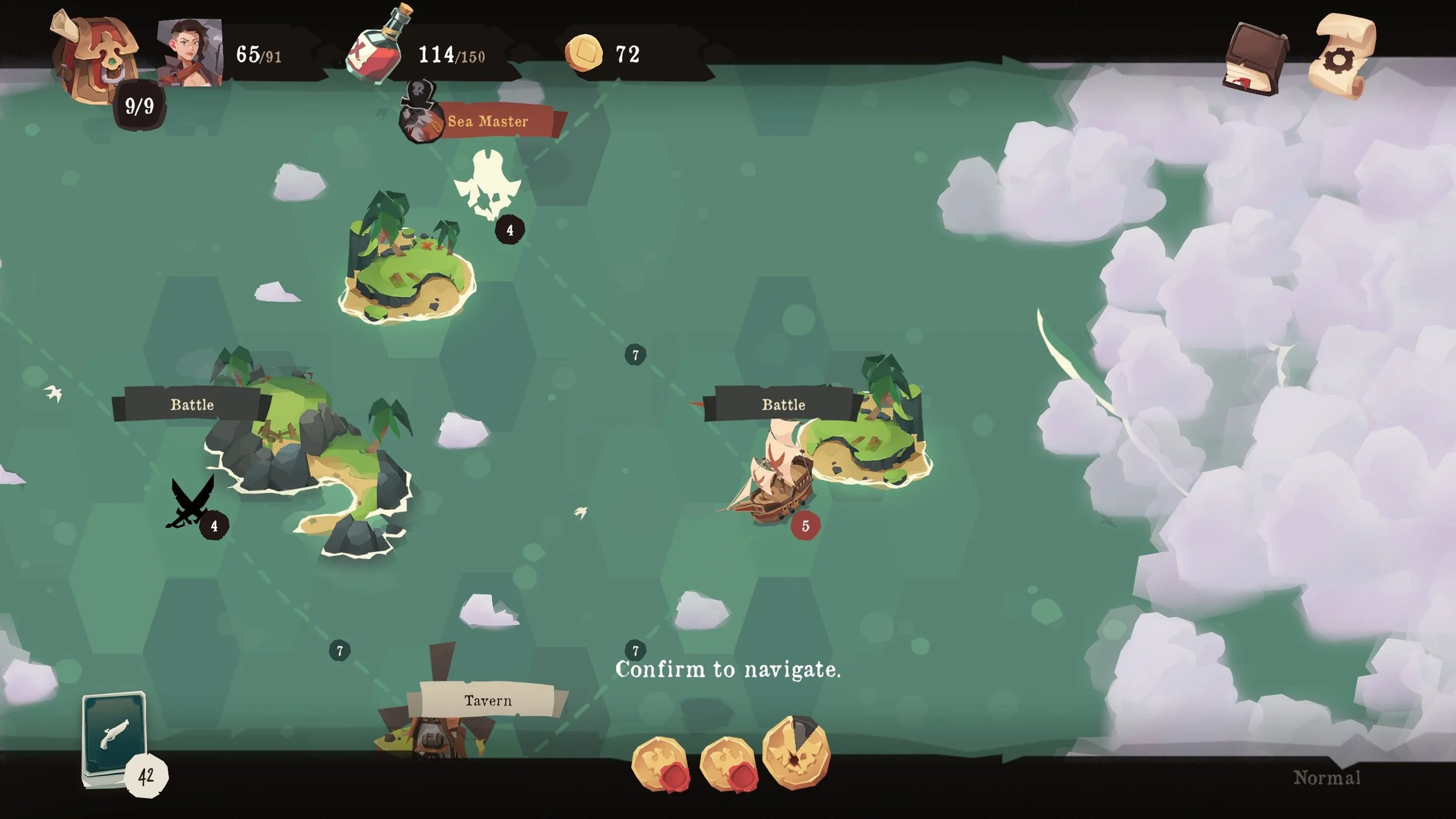
Pirate Outlaws played similarly to Slay the Spire: move up the board, face foes in a card battle to the death, and choose your next path after each victory. Pirate Outlaws 2: Heritage decided to throw that out the window (overboard?). You still move (I guess “sail” would be more accurate) on the map, but the movement is not a “climb” to the top; rather, it's just wherever you choose (between map points). You can literally sail back and forth between 2 stops over and over, if that is your fancy. Every few battles, though, an elite will spawn at a random location. It could be one stopover or three, depending on where you were on the map. Elites only remain in place for so many days (one day passes every time you sail to a new location), so you can elect not to face them by sailing to other spots, although you will miss out on superior loot rewards.
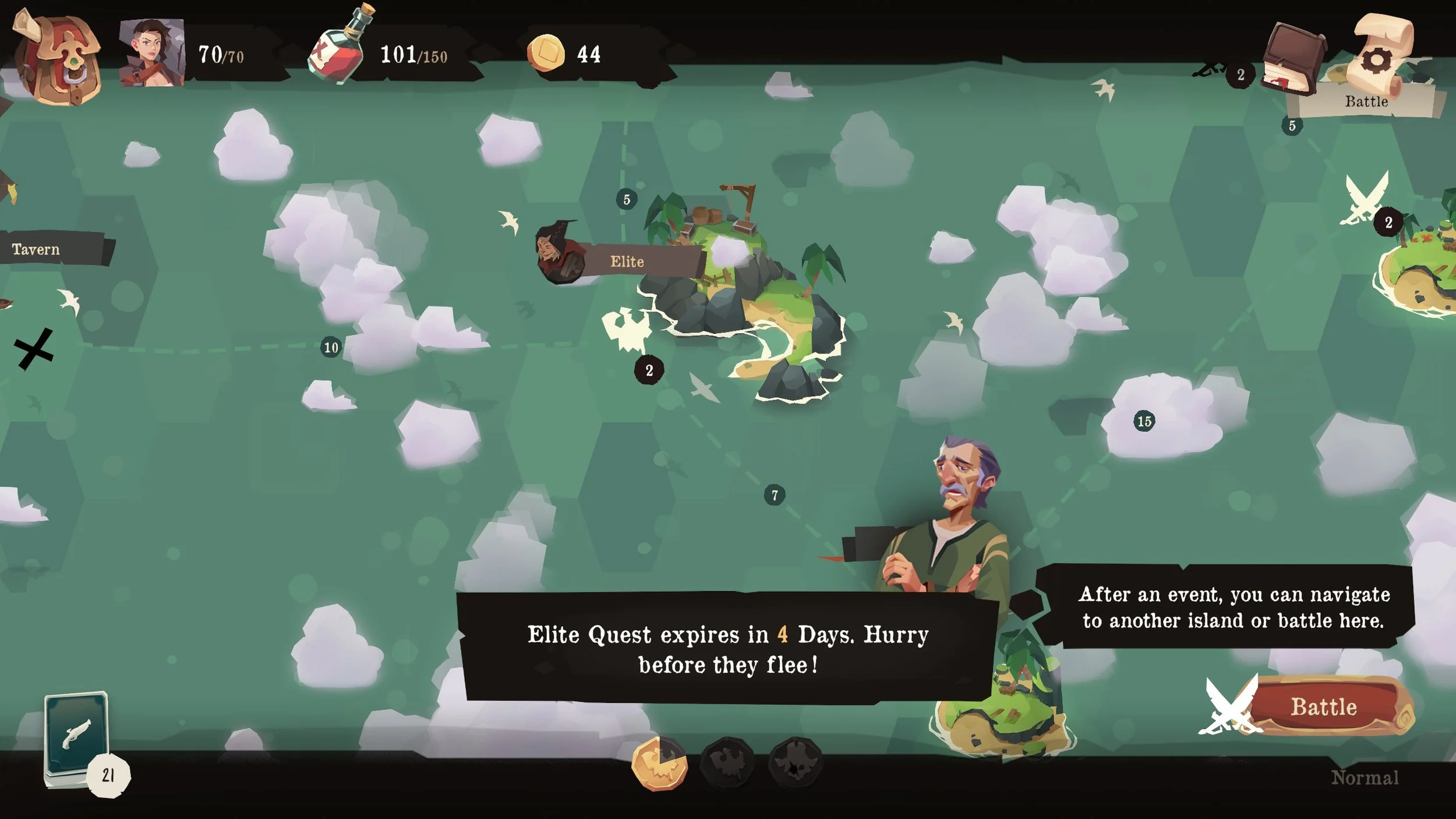
The third elite to spawn is the level boss. I did not try to avoid the boss, but it does have a timer, so one would assume it would just respawn. In the previous game, you had an idea of where a mini-boss/boss fight would happen, and you could make the call to heal at the Tavern or head to the Market. Here, RNGesus can be cruel and force you through 2-3 fights before an elite. Can you take a stop at the Tavern to heal, and hope you make it through the fight leading up to the elite fight unscathed? It is a weird gamble to be forced to decide.
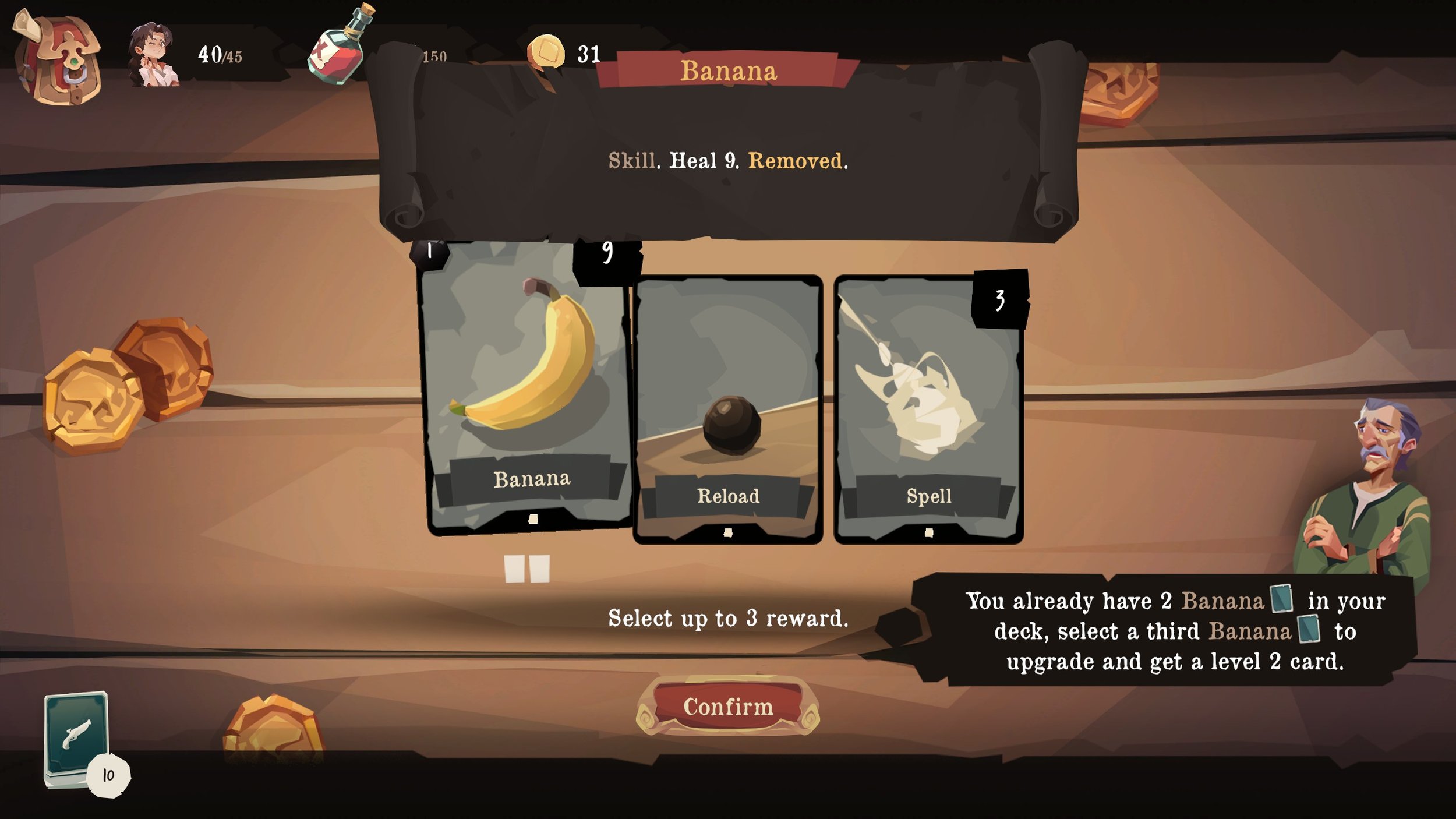
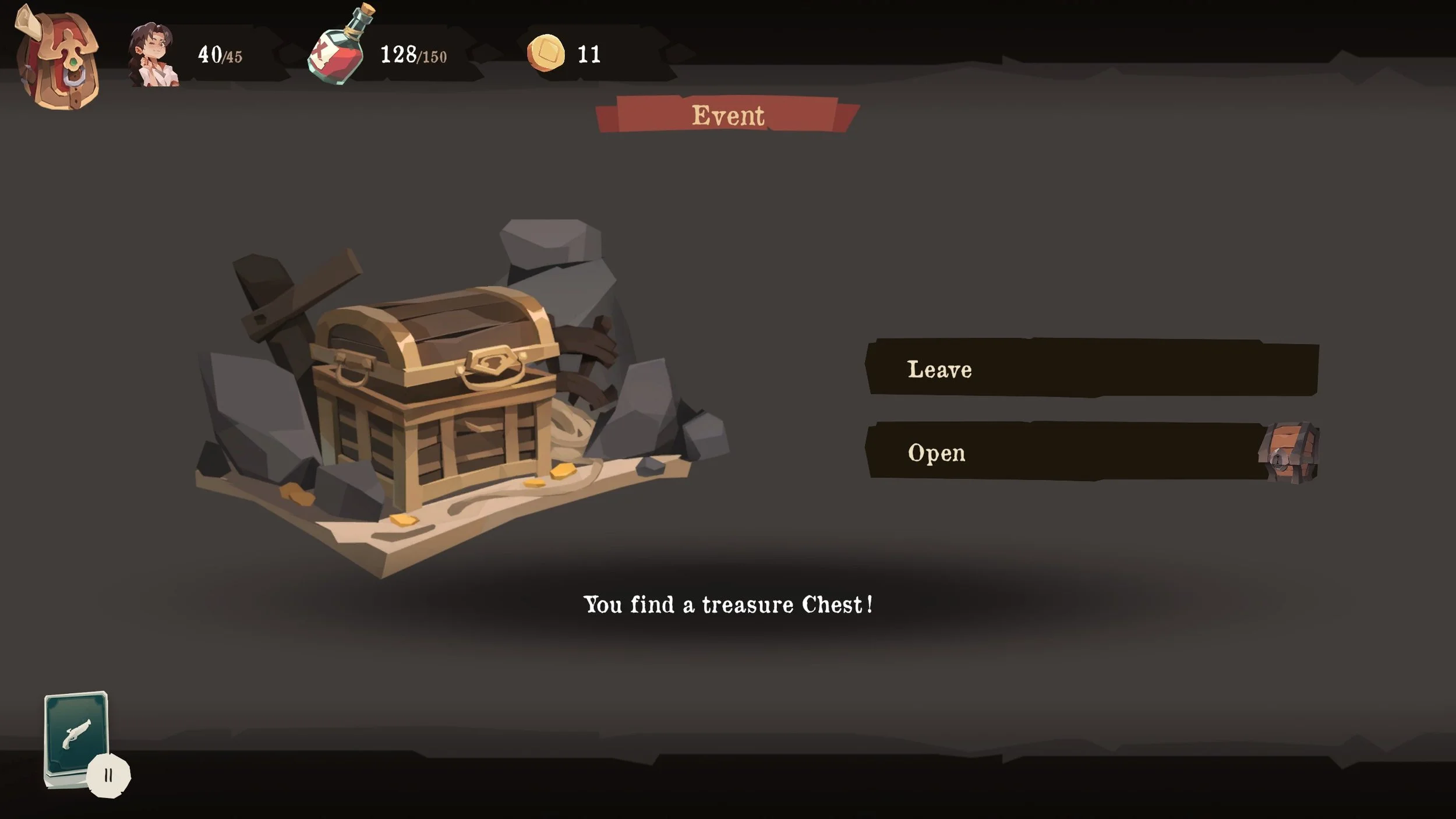
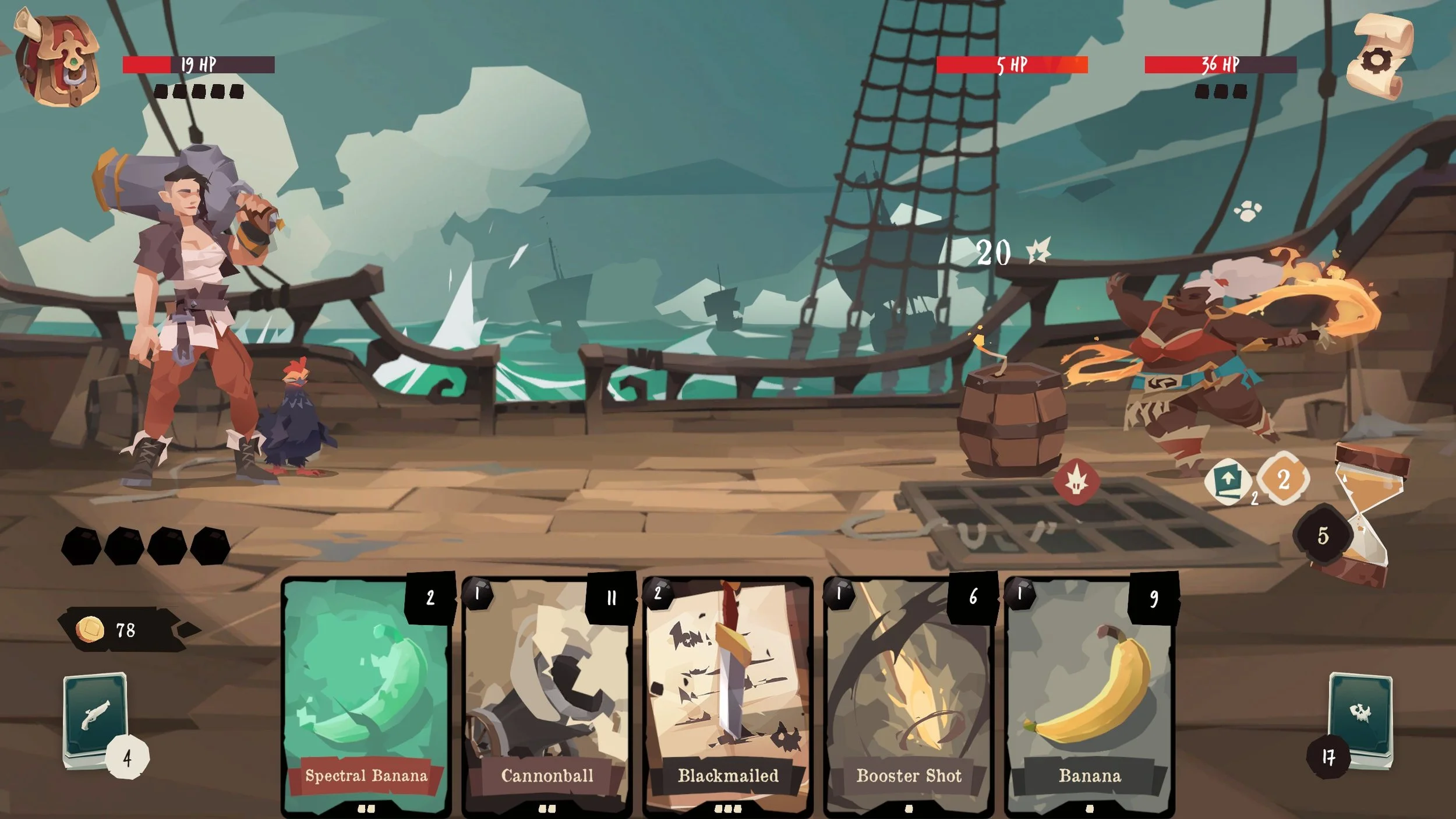
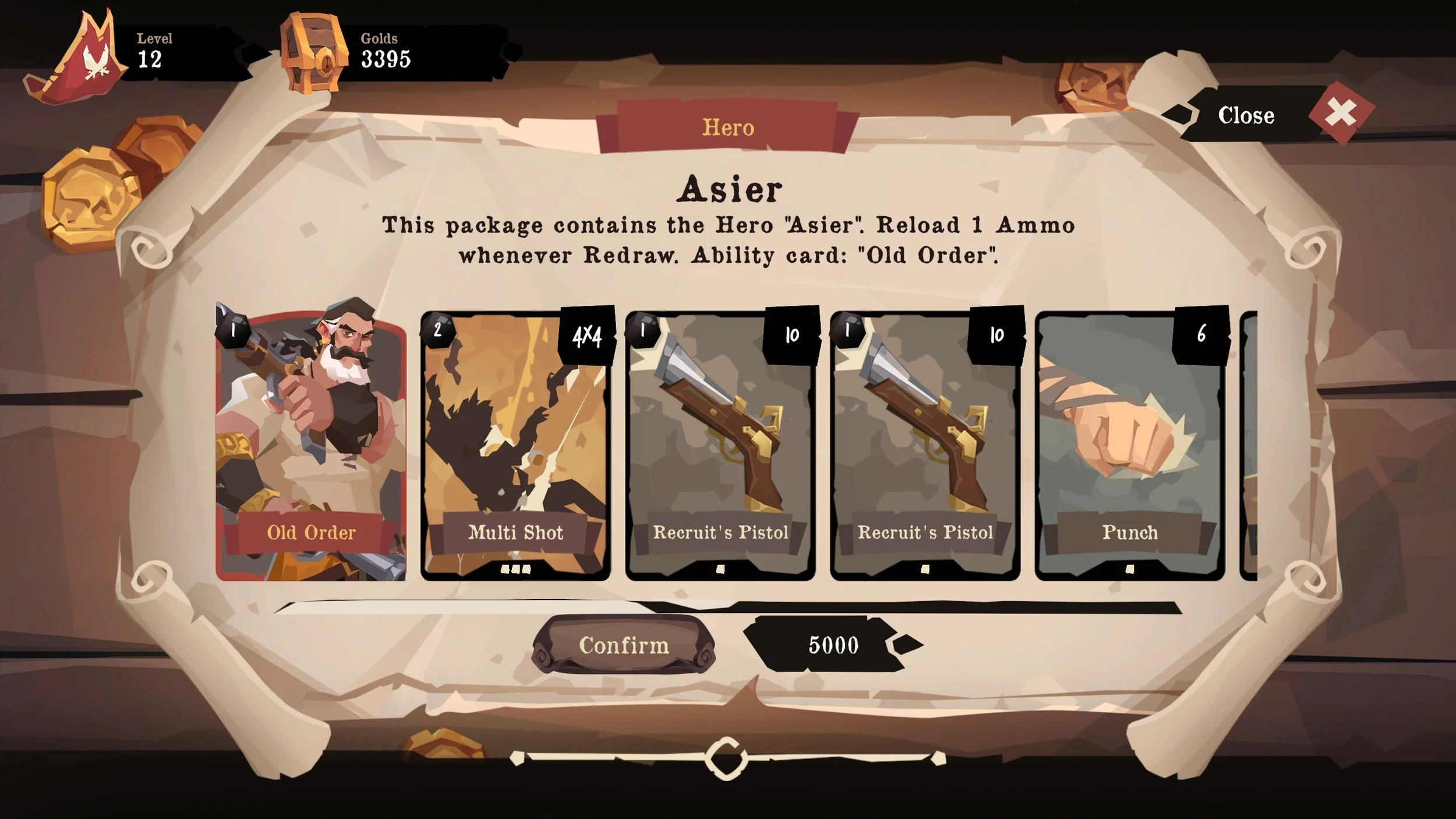
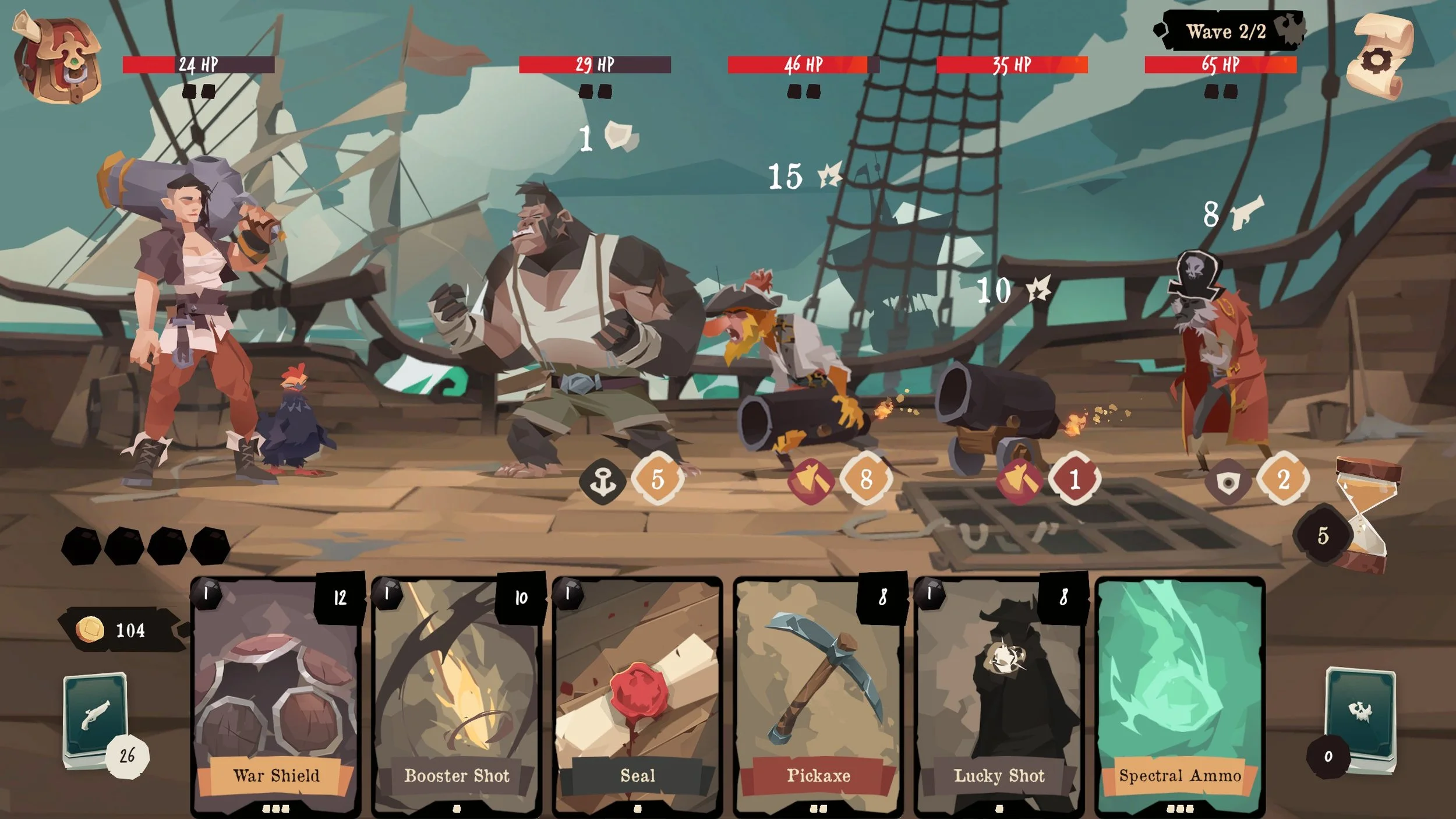
Of course, sailing around is not the focus of the game. Card battles are the real attraction. Each map location contains anywhere from 2 to 4 enemies. Some map locations may even have buried treasure. If there is treasure, after pillaging, you can choose to fight a battle or sail to a new location. Winning any battle allows you to choose 1, 2, or 3 new cards. You can take all three, but you may not want to (more on that in a bit). Depending on your character choice made pre-voyage, you will have a randomized deck of cards plus the unique abilities of the chosen character. The first character, Gabi, has the ability card, Slingshot. Slingshot will attack twice, BUT if you have any stones in your hand and next to the Slingshot card, it will attack an additional time per stone. Another character’s ability heals when the explosive barrel card is played and detonated. This is a change from the first game, as the characters themselves had built-in abilities that just applied when they played versus here, where their unique ability is a card that is played. Despite losing the ability to a card, characters differ in health pools, max ammo, shield slots, relic slots, and redraw countdowns.
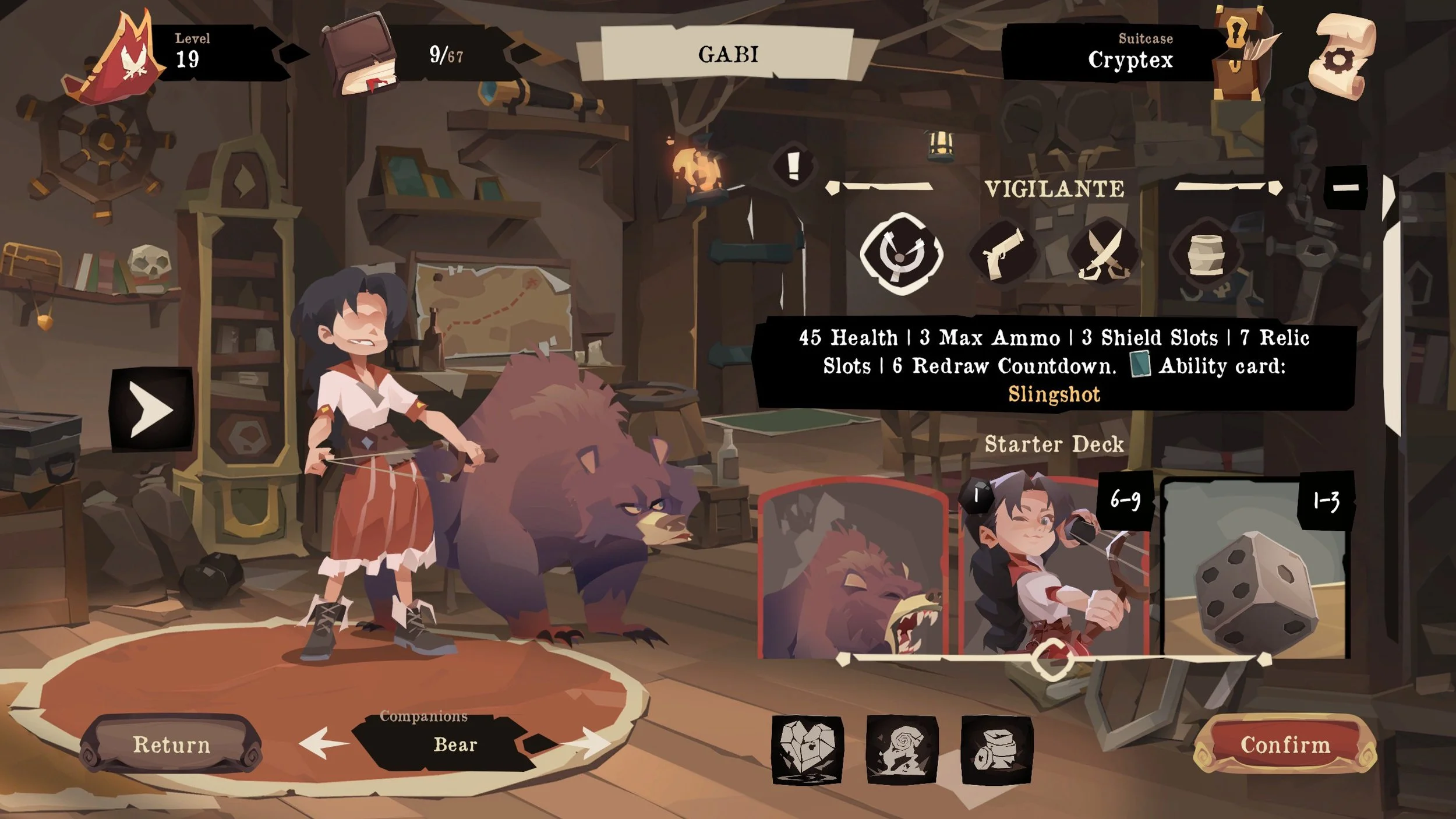
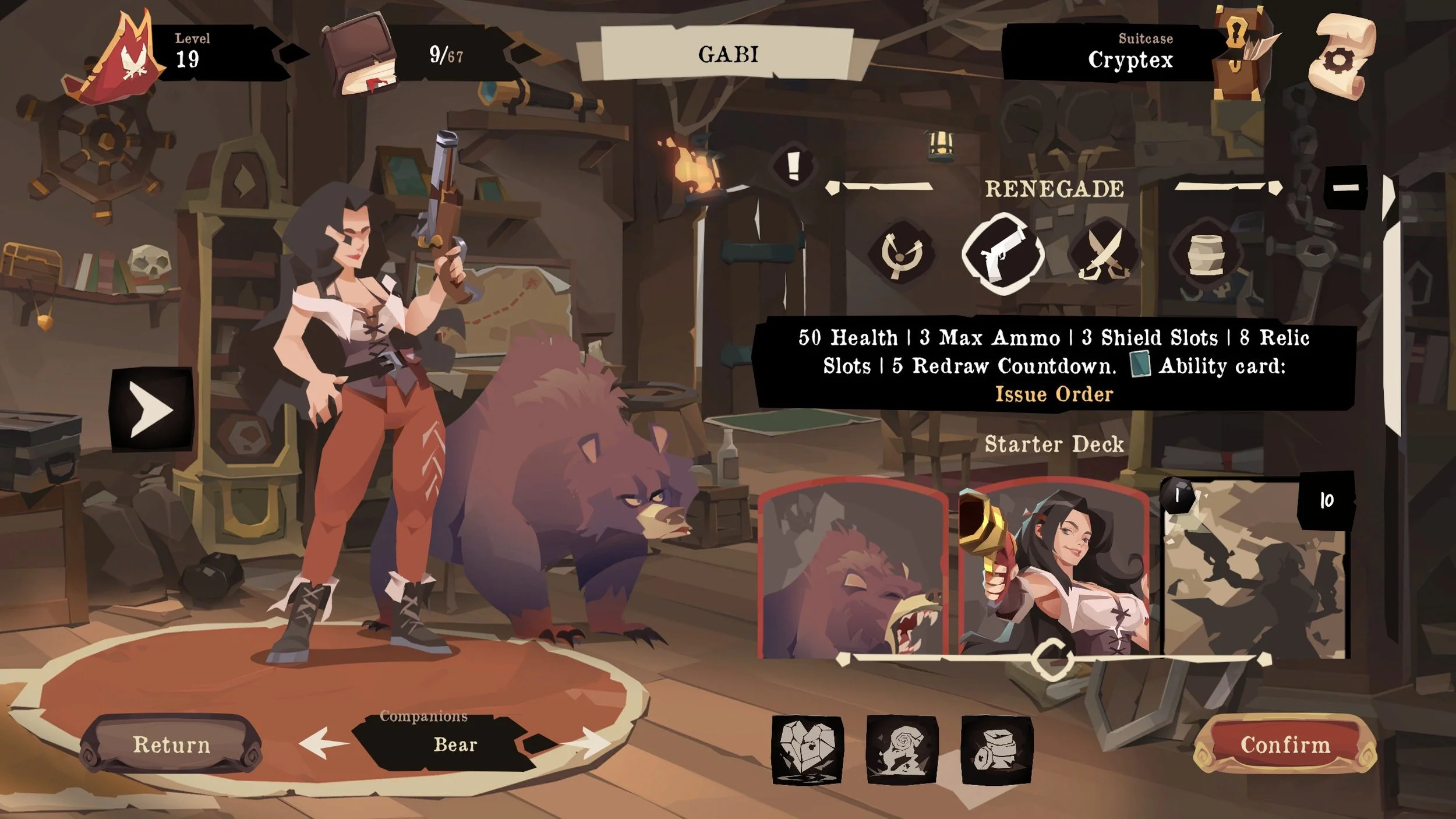
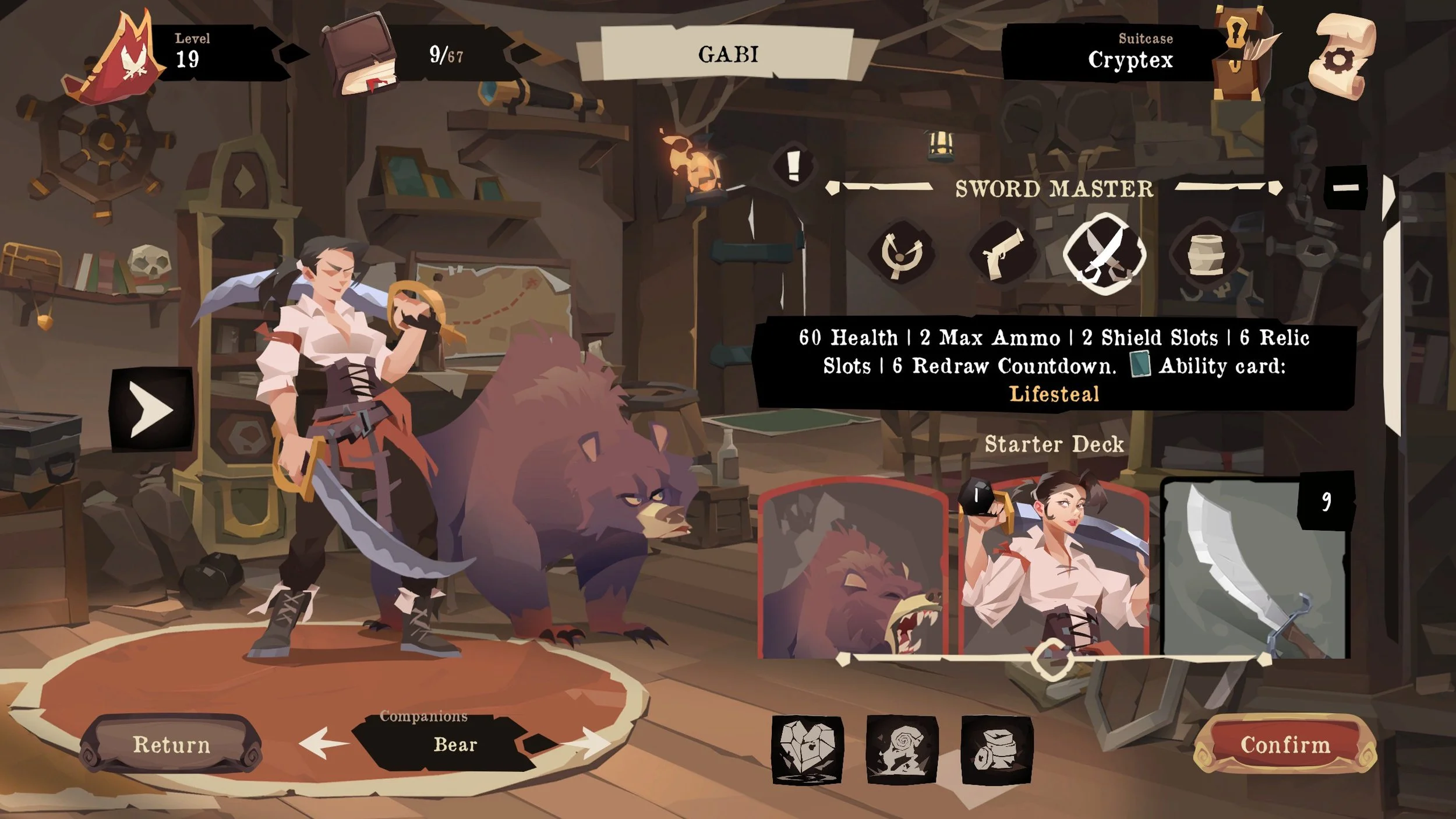
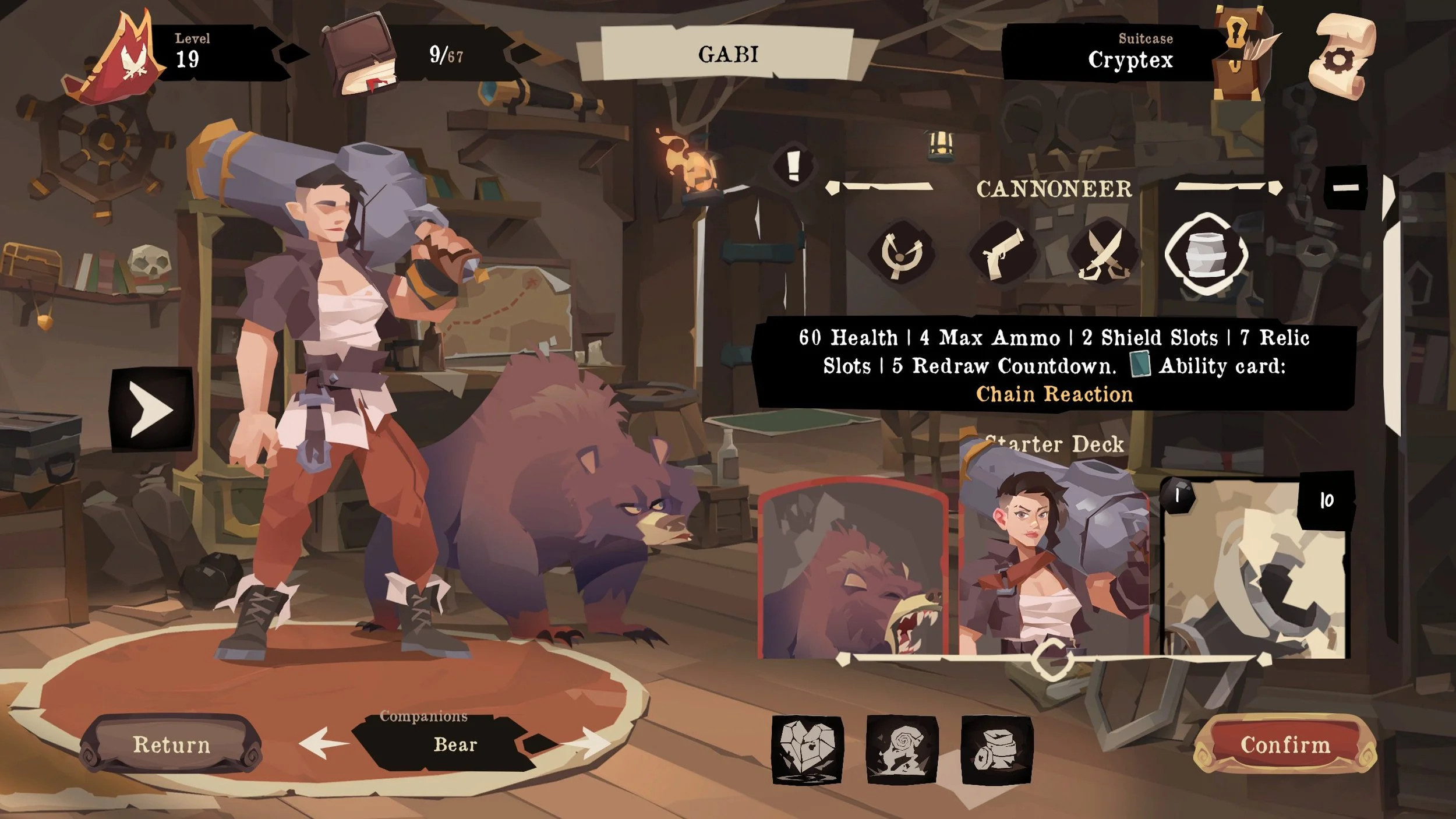
Except for the melee ability ones, cards require ammo to be played. Ammo does not regenerate between turns, so ammo cards need to be played. If you find yourself with no melee cards and no ammo, you must redraw and allow the enemy a turn. That is, if it is their turn. Huh? You will see a countdown timer in the corner of the screen when playing. When the enemies’ countdown under them reaches 0, it’s their turn. If you reach zero, you can play again before them. Essentially, it is like the visual shown in many RPGs, showing who goes and in what order. Almost all actions take one off the timer. If you are forced to redraw early (due to no ammo), the number under your timer will be subtracted from each enemy timer. If it seems convoluted, that is because it is convoluted. Some cards can increase the enemy timer, and some cards can be played that do not count as an action. The problem is, you have to draw those cards, and there are not an abundance of them in your deck. At the end of the day (or battle), it just becomes a back and forth as if the timer was not even there.
Another change from the first game that took a bit to get accustomed to was how the shield worked. In the first game, shields had a block value. A shield with 5 would block 5 damage. If an enemy hit you for 20, you would only take 15 damage to your health. In Pirate Outlaws 2, shields just block the next attack. This simplifies things by making shield use more of a strategic play. It ties a little into the countdown mechanic, too. Blocking the next attack is well and good, but you would rather block a 15×2 attack and not a 1×2.
When you hear upgrade, you probably think of an improvement. Card upgrades in Pirate Outlaws 2 are more of a sidegrade, at best. The system as a whole is a bit of a downgrade from the first game. The first game had clear upgrades for the cards. You paid gold and got a better card.
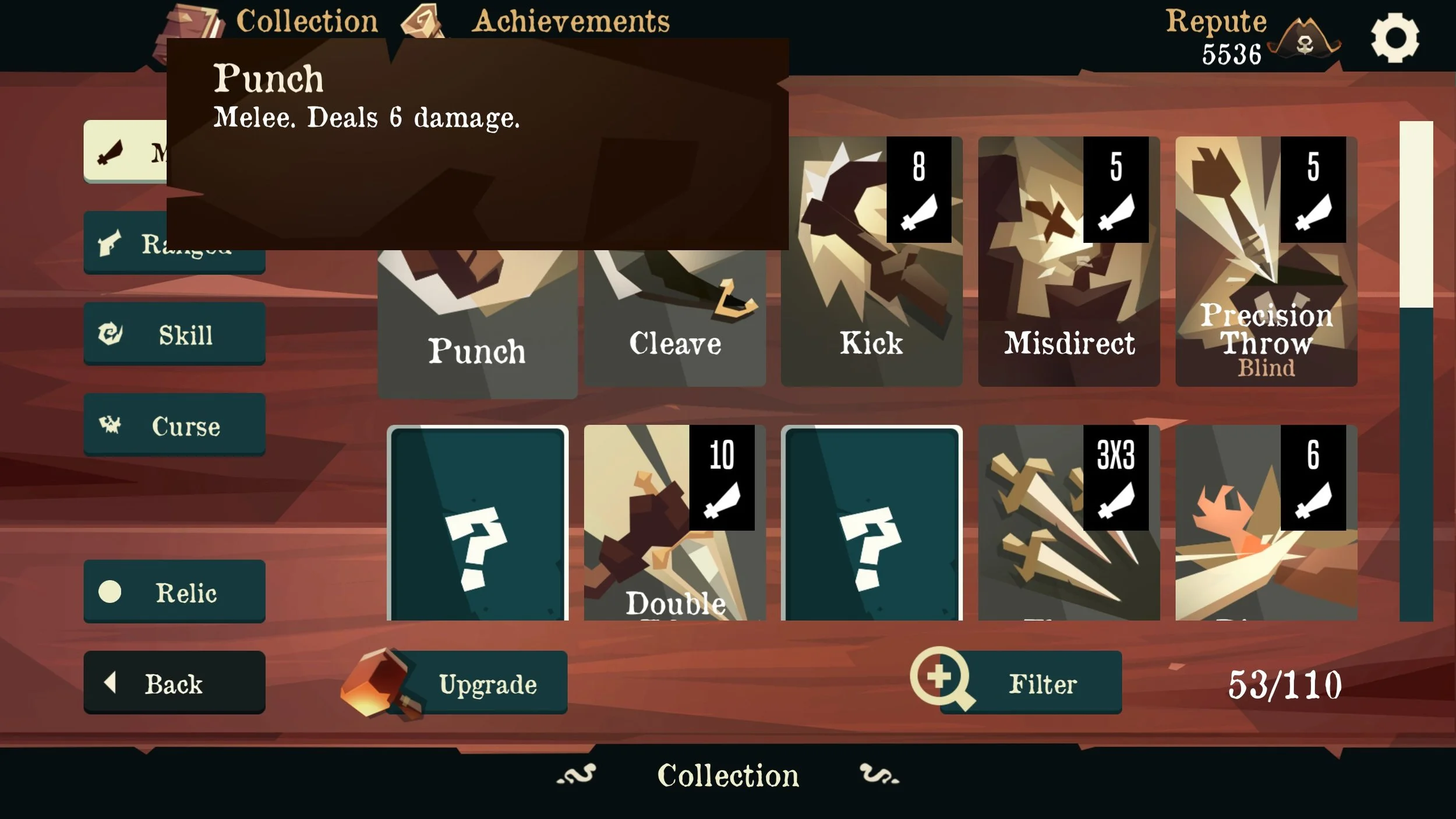
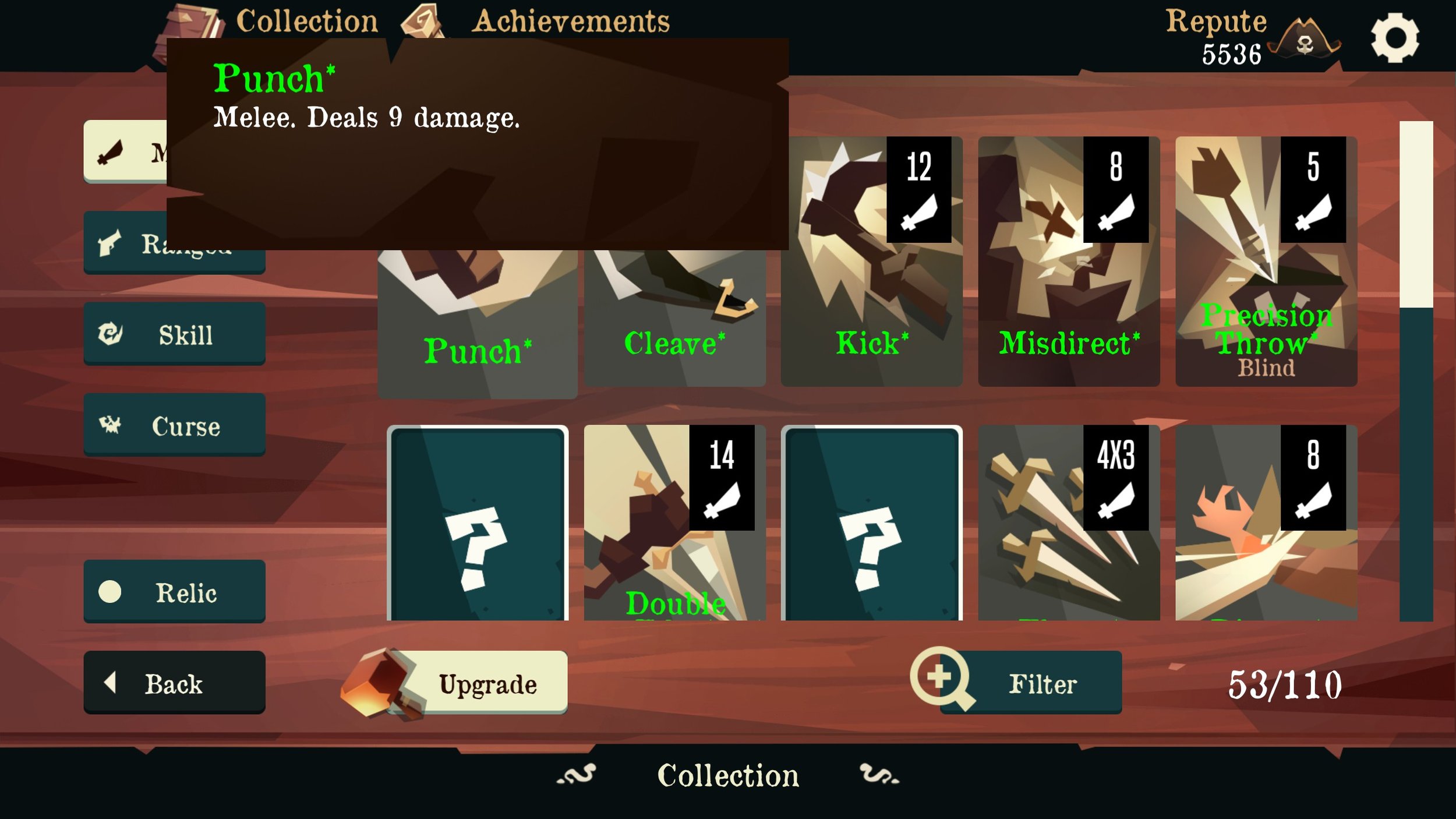
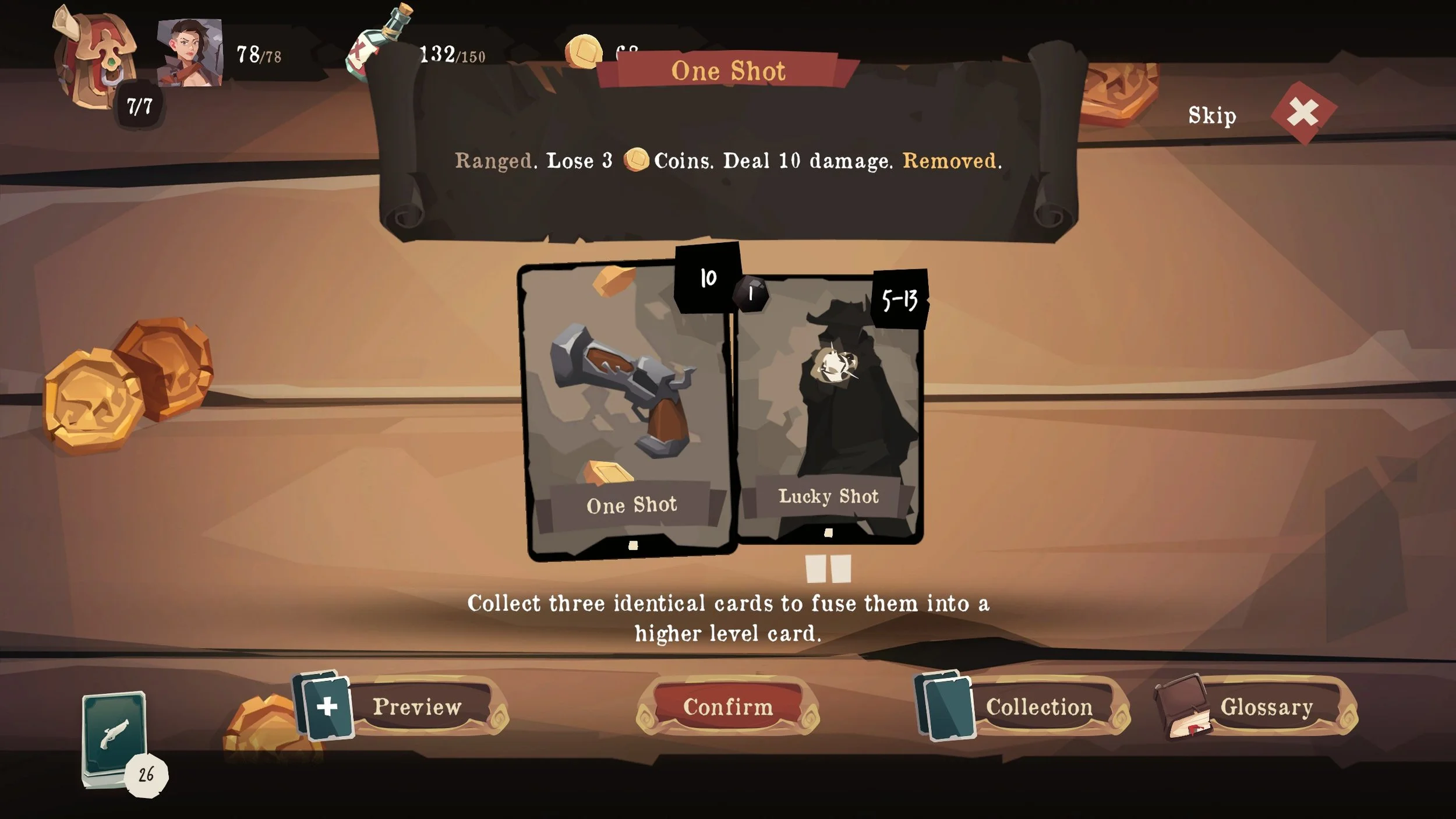
Whenever you hold three of the same card in your deck, you can combine them into a new card. The problem lies in the fact that the new cards are not necessarily better, and now you have two fewer cards in your deck. As far as the cards not being better, it does not apply to all upgrades. Also, the third tier of upgrades may be worth suffering through the first upgrade. Sometimes, though, the card completely changes. For example, Junk Stone “Deal 3-5 random damage…” The upgrade path is either Painted Stone (Reload 2 Ammo) or Pile of Stones (Deal 1-7 damage to all enemies…). You either upgrade for a reload or additional damage.
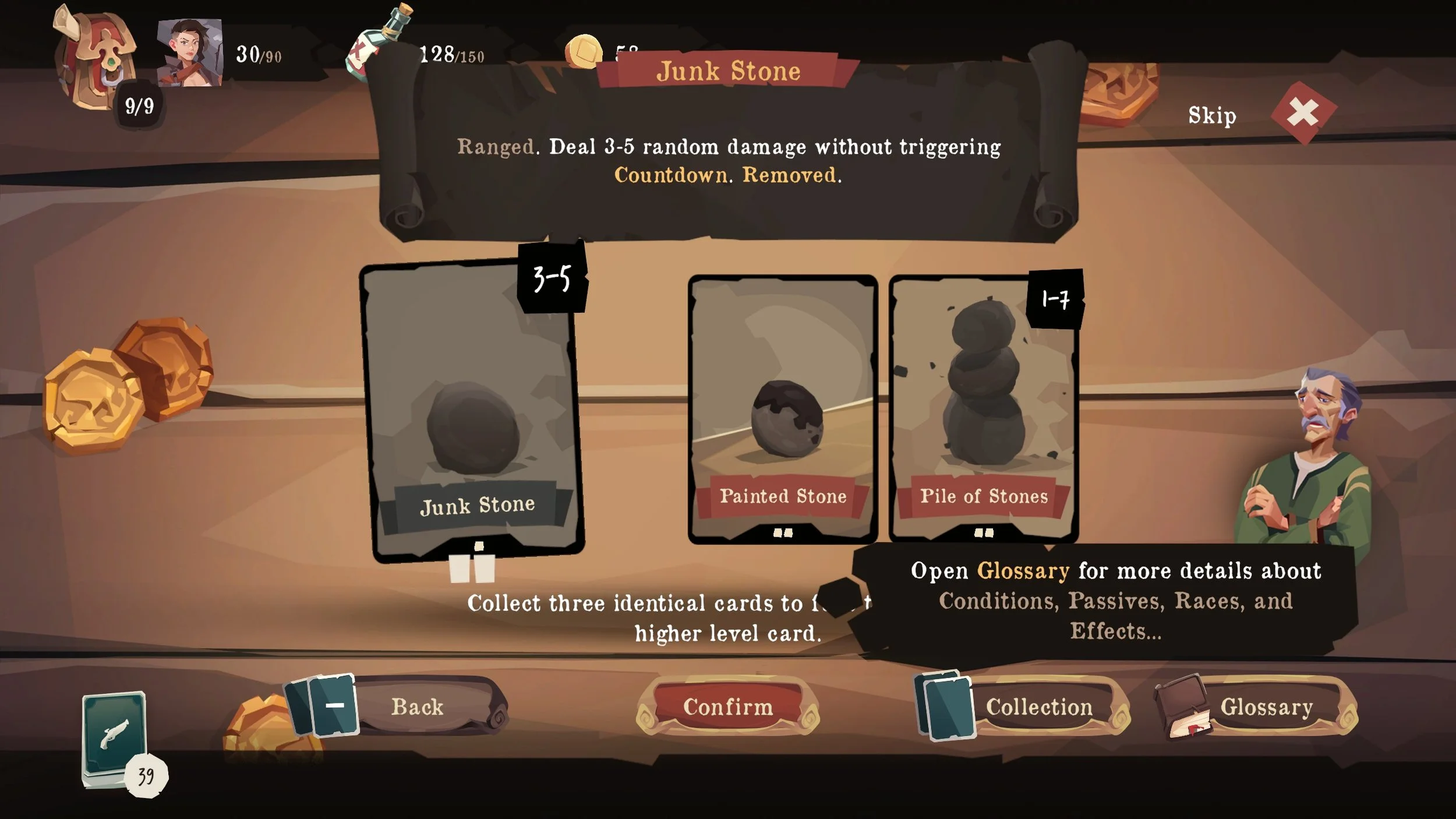
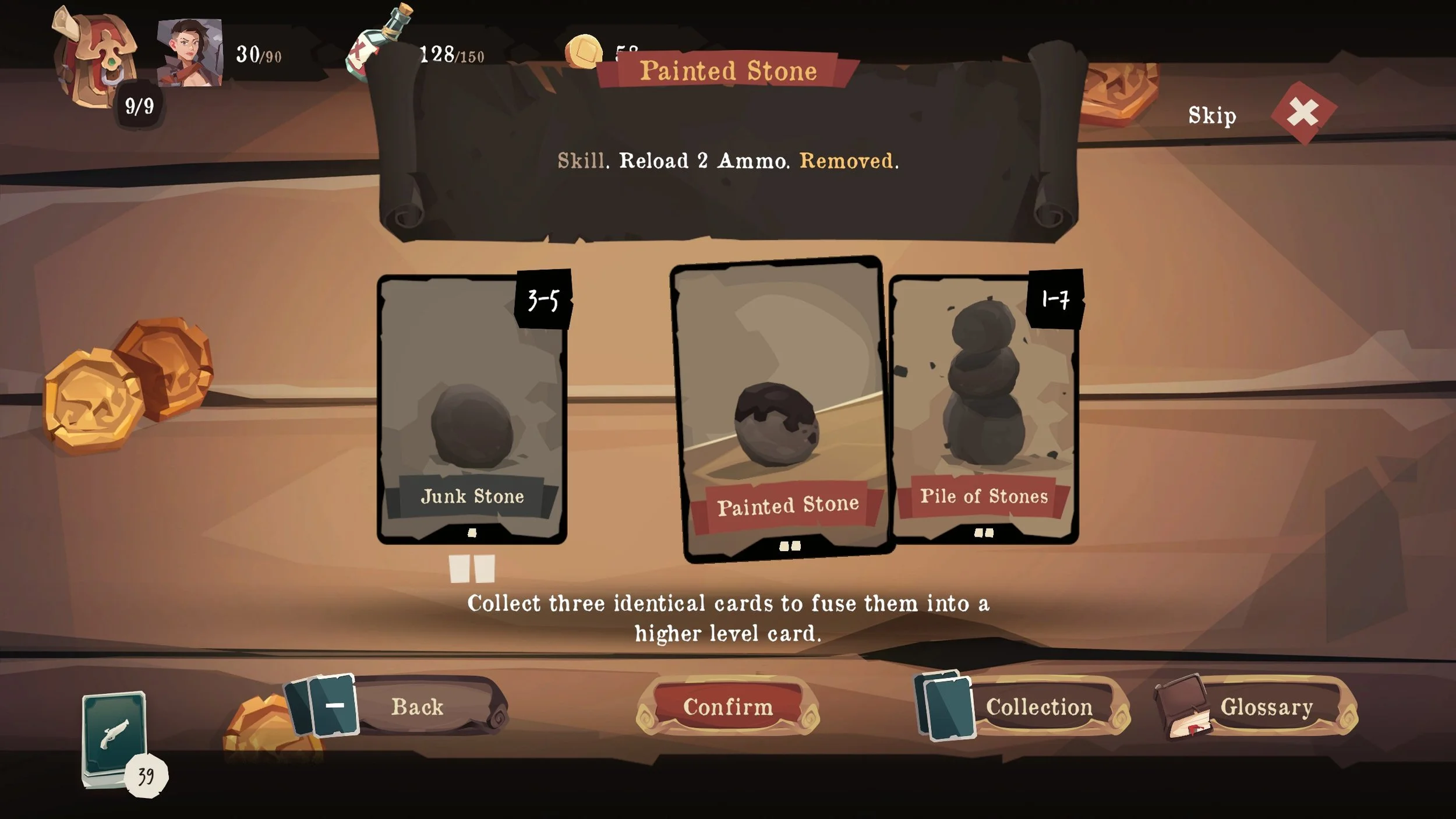
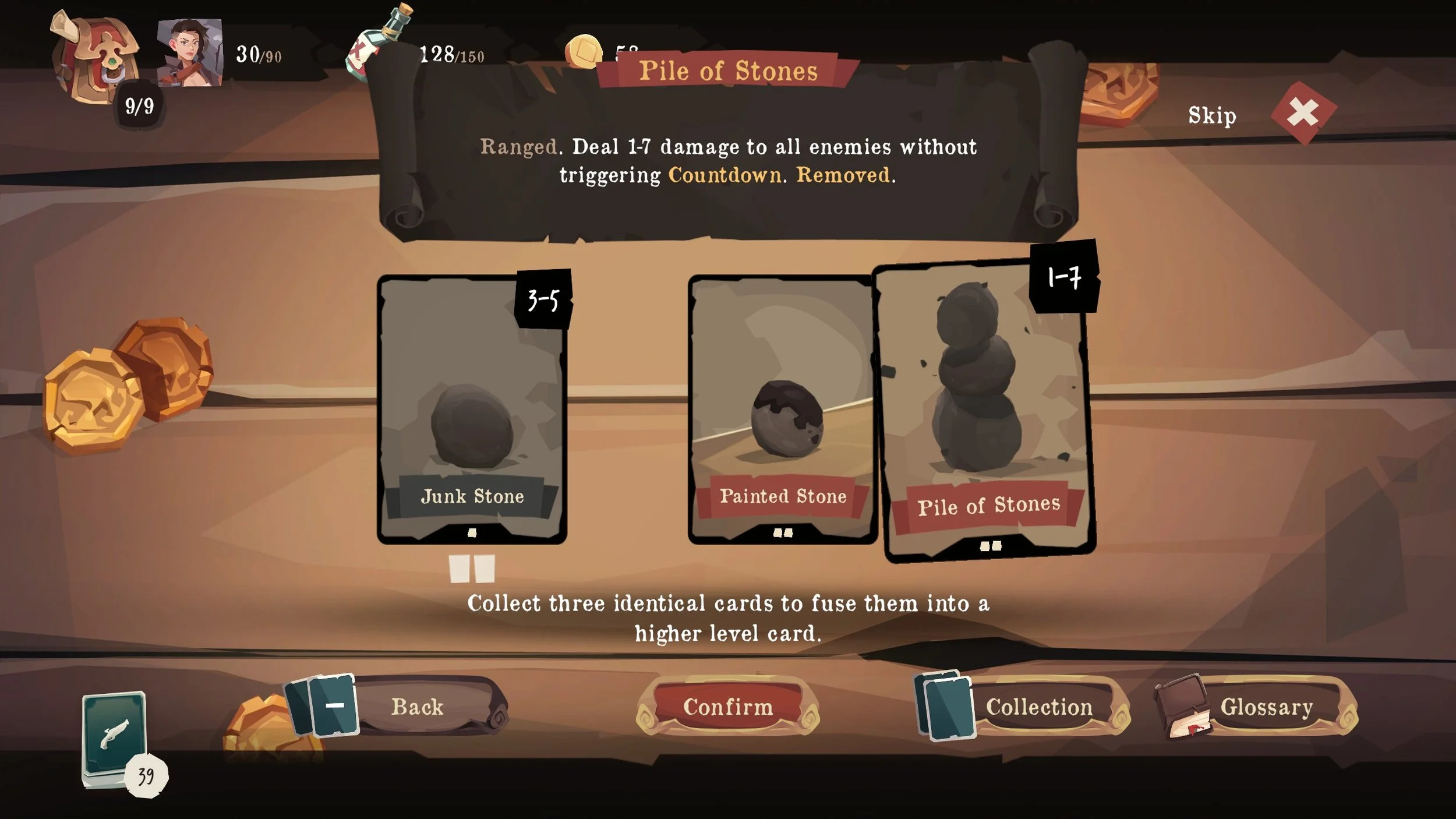
Another example is Punch. Punch deals melee damage. The upgrade choice is Kick or Pull. All three do melee damage, but Kick and Pull both alter the order of enemies. Melee can only be used on the first enemy in the line. If you Kick that enemy, you have to focus any other melee damage on the new enemy in front. Sure, it has its benefits, but it could do more harm in some situations. Fortunately, you can opt not to choose the card, although I wish you could choose not to upgrade.
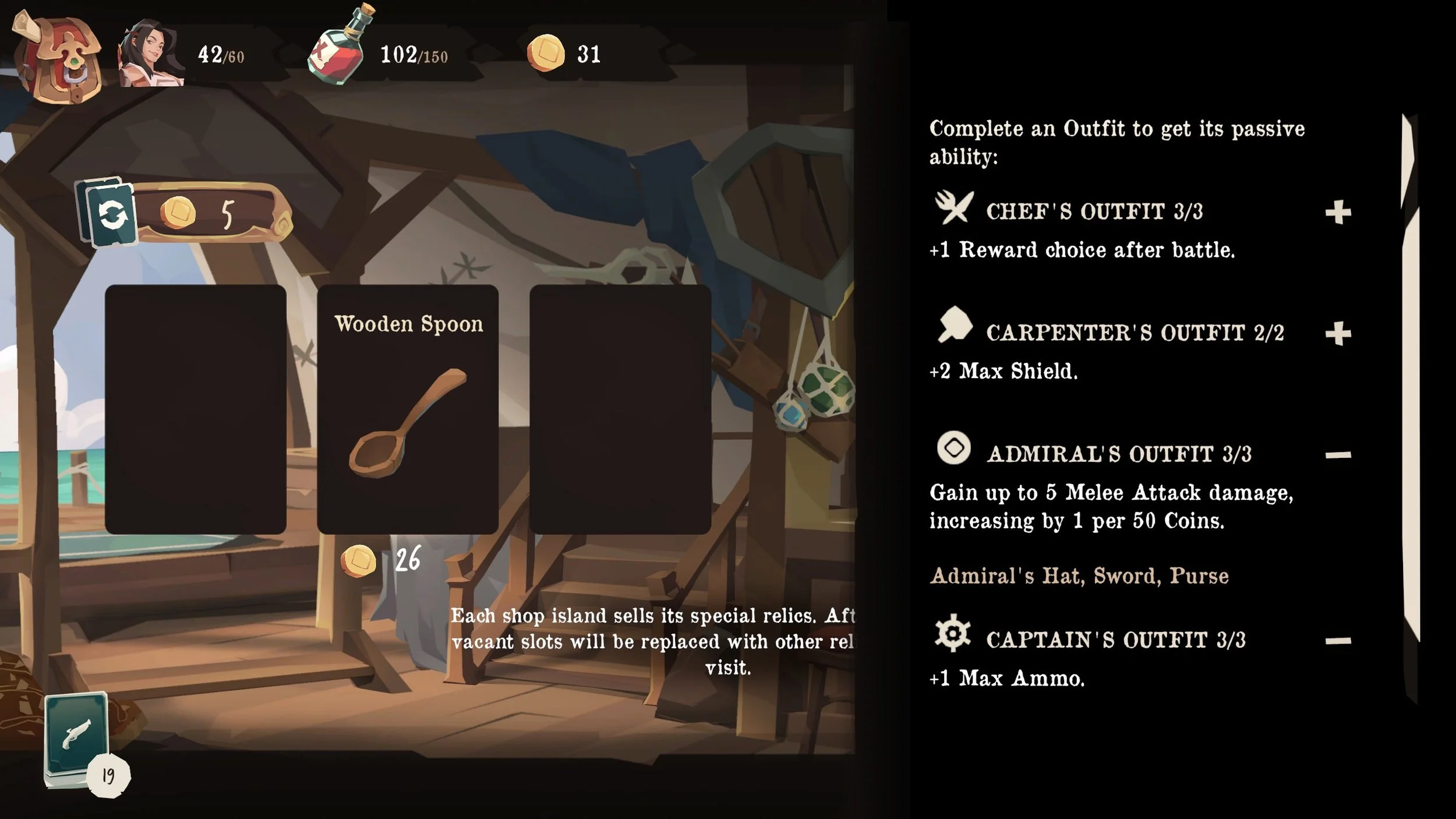
When not sailing the Seven Seas, there is quite a bit to do on land. The Tailor provides the opportunity to customize your character with fresh threads. You should look good while pillaging all that booty. The Pet Shop lets you pick a traveling companion. Pets come with their own set of cards that get shuffled into your deck. Currently, there are 4 available pets in this build of the game: chicken, wolf, bear, and octopus. The alchemy shop unlocks new classes for each hero. This was misleading, though, as each class is entirely different (looks and playstyle). The only thing I can think of is if the heroes being added to the game down the road have different decks. The Caravan sells new relics and cards that can appear on each run. All of these require gold earned from each run. You will also collect gemstones after each run, win or lose, which can be used at the Blacksmith and the Black Market. The Blacksmith can craft golden versions of existing cards (these are direct upgrades to existing cards, similar to the first game’s system), and the Black Market can ban cards from appearing on a run.
ACCESSIBILITY
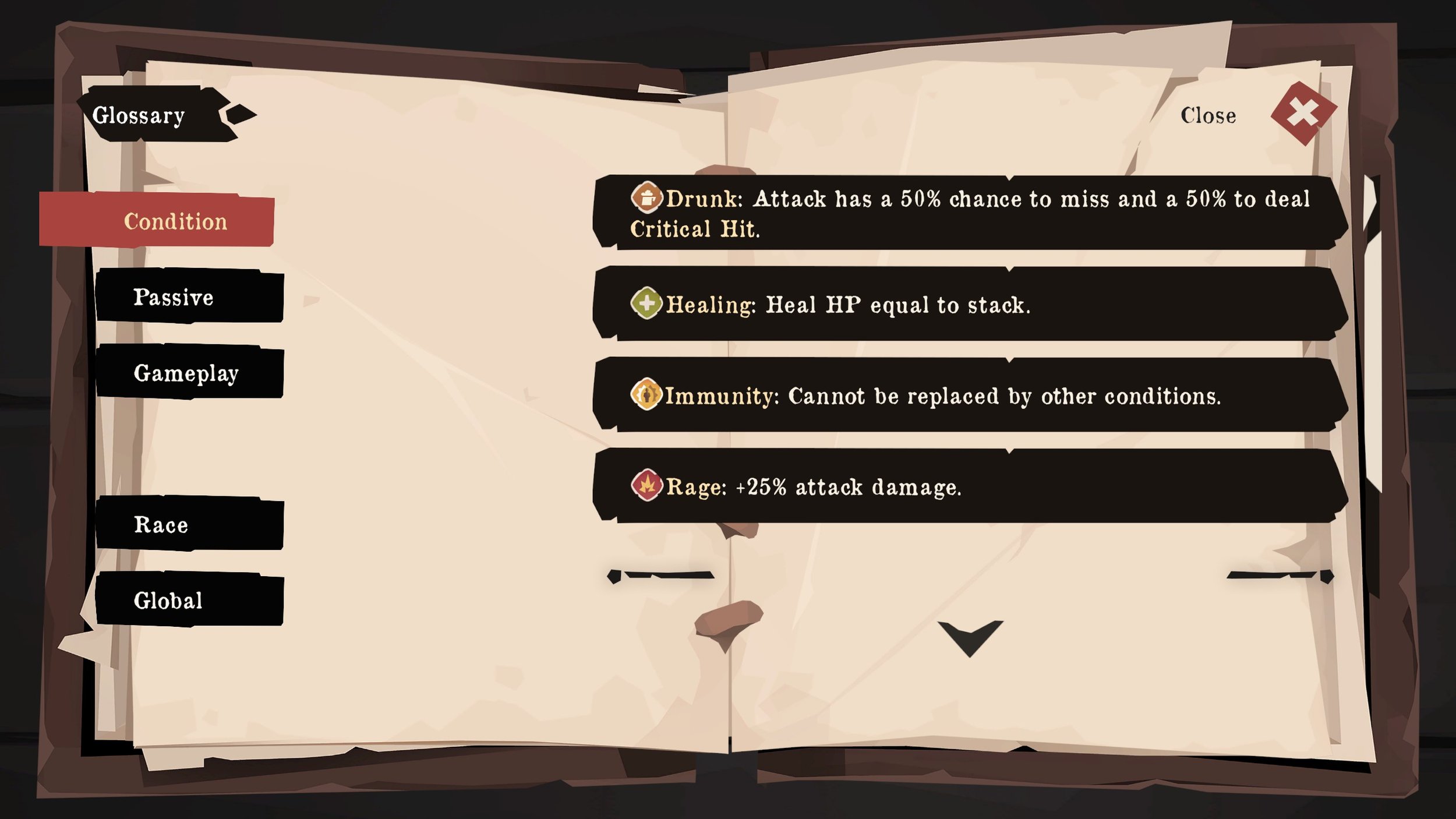
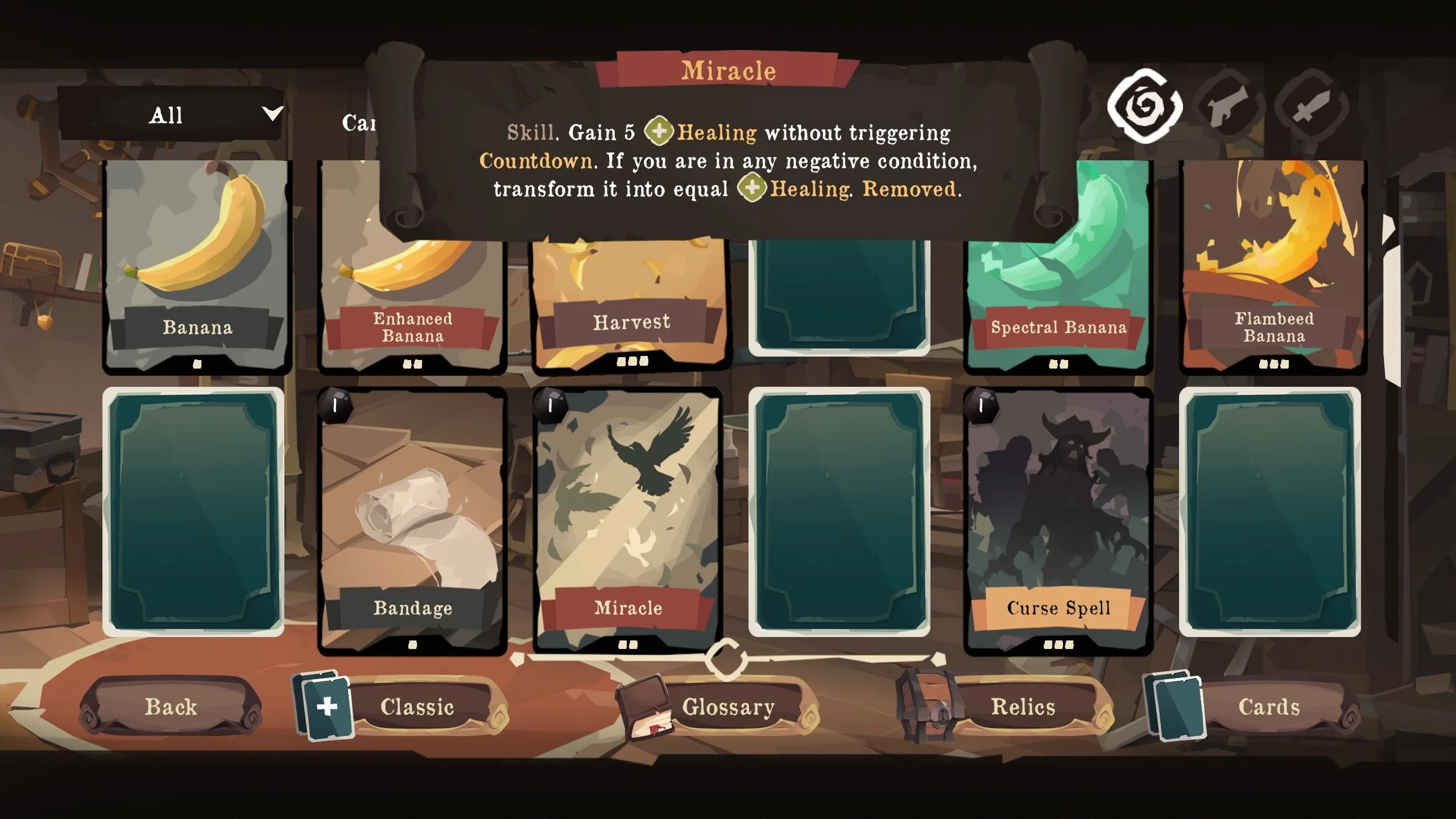
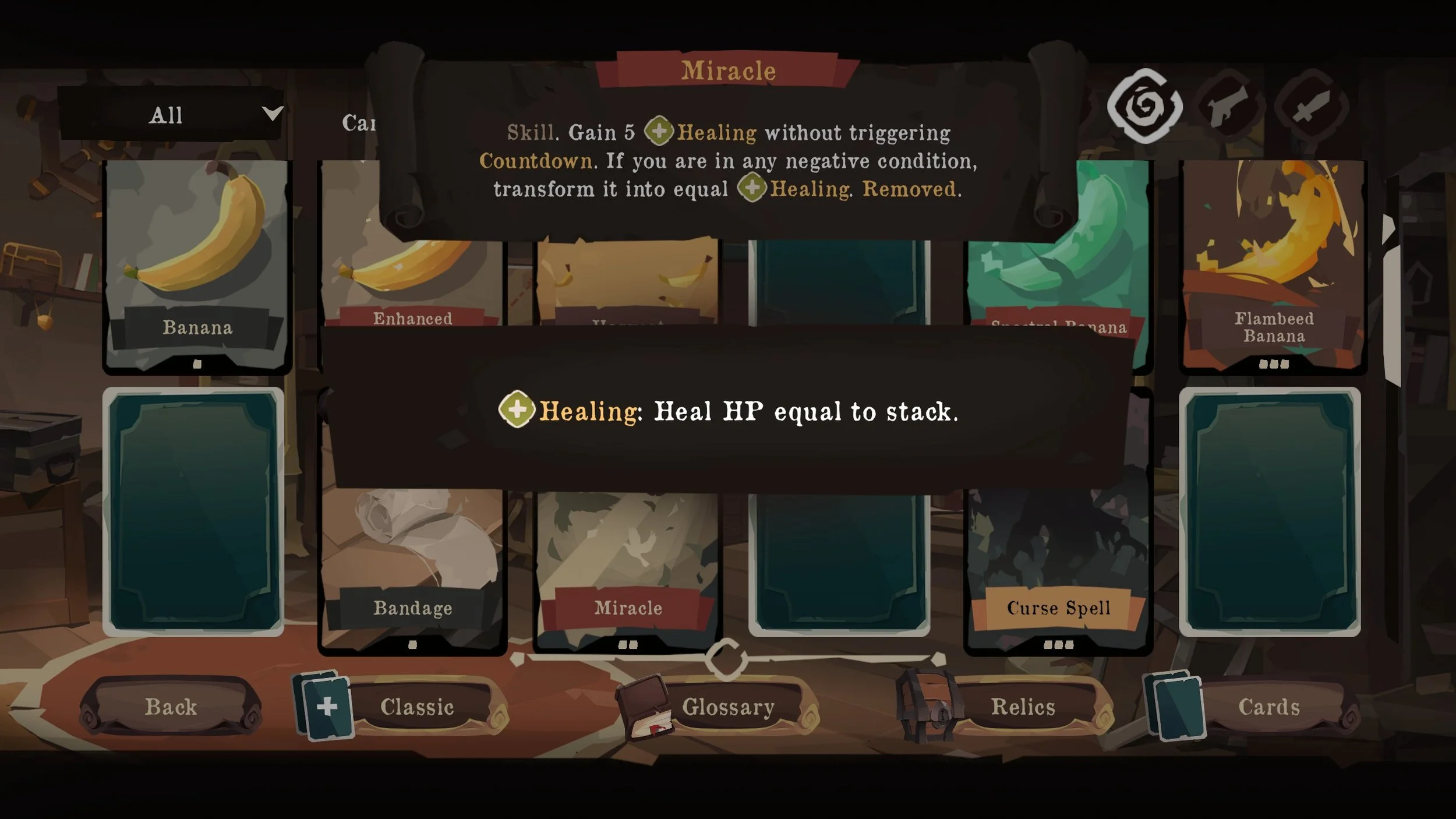
Normally, I would highlight the different options available in the game, but Pirate Outlaws 2 contains your standard set, including 9 available language choices. What I wanted to point out was the extreme level of user-friendliness. Every card, every status effect, and every enemy can be clicked on at any point while playing, and a full description is available. I know games with several systems going full speed all at once can be a hurdle for many gamers, so having that refresher at the ready is a phenomenal feature. There is even an in-game glossary that further covers each term.
FINAL THOUGHTS
Early Access should definitely be the time for a game to try things out and get player feedback about new features.That said, if it ain’t broke…Pirate Outlaws was a truly underrated title, but it was a joy to play. The artstyle and audio design do make their returns and were one of many facets that made the game a hit for those who played. There are just too many new systems in play in Pirate Outlaws 2: Heritage that either do not work or need a rework. On paper, the freedom to sail the open sea versus a structured path sounds great. In reality, you just sail around, probably close to the Tavern for emergency heals, as you wait for the elites to spawn. Personally, I liked hitting a boss fight in the first game and hoping I had the health. Here, I do not like thinking, “I should have healed and chanced an extra fight before the boss.” Perhaps there could be more paths or even shortcuts that cost additional rations so you do not feel like you have to play it safe so you have a fighting chance against those elites and bosses. The redraw/cooldown mechanic needs a bit more attention because, in its current state, it is just a distraction. There are limited ways to affect it, and brute force through enemies just seems easier at times. The shield change grew on me. If you did not play the first game, it will be a complete non-issue. Ammo management does need work, though. Too many times did my hand contain all ranged cards with no ammo remaining, and simply hitting redraw got me killed. The inability to rearrange your hand needs to be looked at, too. Many of the unique cards enhance adjacent cards or are enhanced by adjacent cards, but RNG is never to be counted on. Even if there is a limit to rearranging cards once more battle, it would be a huge QoL upgrade. Last, but certainly not least, is that the game is incredibly grindy. The cost of everything at the merchants is obnoxiously too high, or the game is just incredibly stingy on currency payouts. Winning a run does net you a bit more than losing, but winning is not guaranteed. Some of the later upgrades that I could not afford seem like they could completely change the tide of battle, if I ever can afford them. I mean, it makes sense that the longer I play, the easier it should become, but it feels too much of an uphill battle to encourage continuous play. For fans of the first game, put this on your wishlist and watch it during Early Access. Those of you brave enough, grab it and make sure to provide feedback. If this type of game does interest you and you were unaware of the series before now, pick up the first one and enjoy that before entertaining the sequel. This one still needs time, or it will end up in Davy Jones’ locker.